

Shutterstock
Explore
The Attention Spectrum: It’s Not Always ADHD
“Why can I focus on a video game for six hours but can’t spend five minutes on an email?”
If you’ve asked this, you’ve likely fallen down the rabbit hole of internet diagnosis. But attention issues aren’t binary. Dr. Edward Hallowell introduced the concept of VAST (Variable Attention Stimulus Trait) to describe a specific type of brain wiring that differs from clinical ADHD and Situational Inattention (stress/burnout).
Here is the breakdown of how your brain might be wiring its focus.
🌿 The Core Definitions (Root)
1. VAST (Variable Attention Stimulus Trait)
What it is: A descriptive, trait-based lens. It frames attention as variable based on interest, not “deficit.”
Key Driver: The “Interest-Based Nervous System.” If it’s interesting, you engage. If it’s boring, you tune out.
Status: Not a disorder. It is a way of understanding personality and cognitive style.
2. ADHD (Clinical Disorder)
What it is: A neurodevelopmental disorder defined by the DSM-5.
Key Driver: Persistent inattention, hyperactivity, or impulsivity that causes functional impairment in daily life.
Status: A diagnosable medical condition requiring evidence-based treatment.
3. Non-ADHD (Situational)
What it is: Behaviors that mimic ADHD but stem from external factors.
Key Driver: Stress, sleep deprivation, anxiety, or environmental mismatch.
Status: Temporary or Conditional. Fix the root cause (sleep, stress), and focus returns.
⚡ The Mechanics: How It Feels
We can distinguish these three states by looking at their “Process Flow”—how the brain reacts to a stimulus.
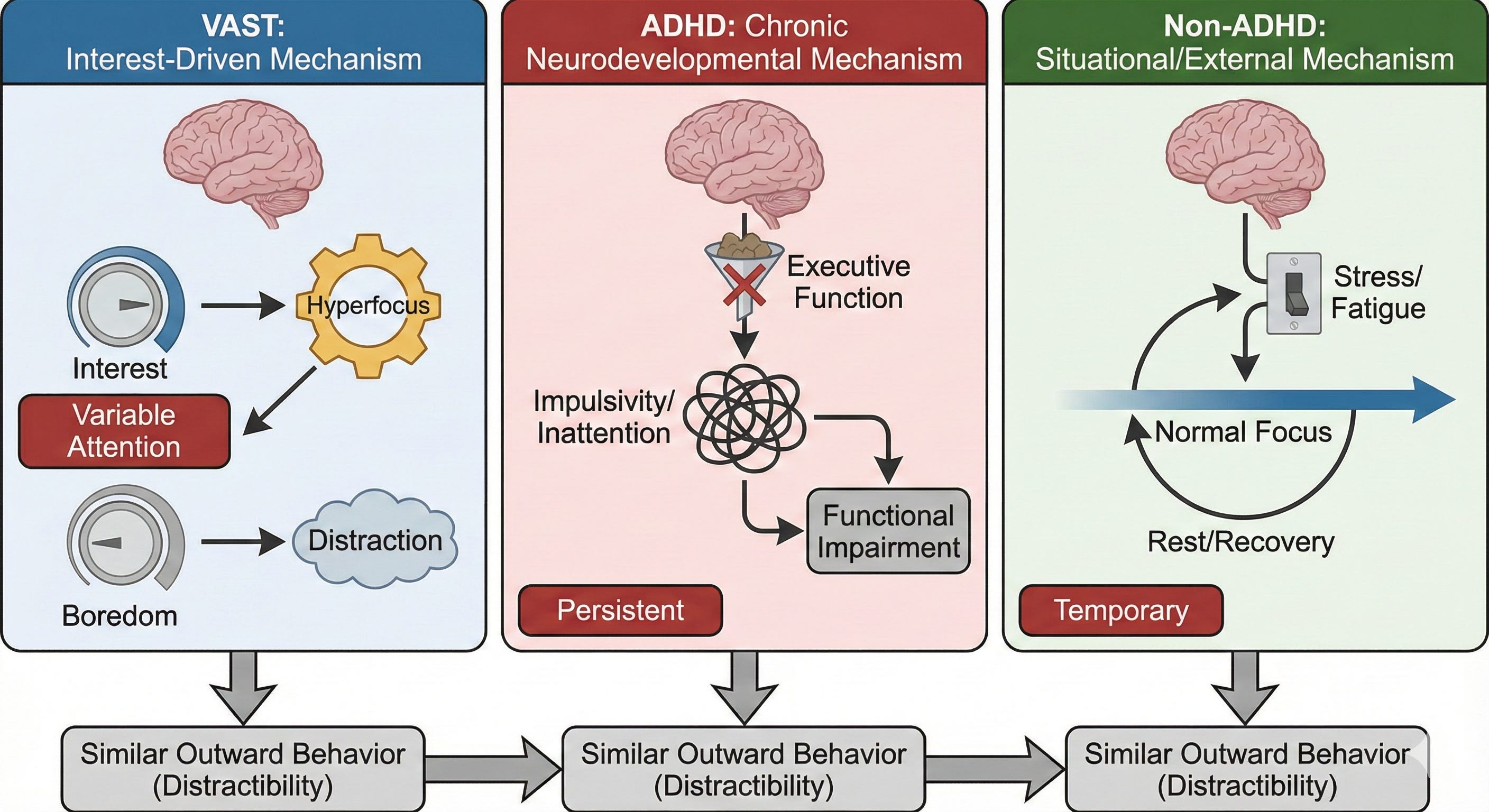
⚠️ Crucial Distinction: VAST focuses on strengths and variability. ADHD focuses on impairment and support. Non-ADHD focuses on lifestyle and environment.
I used to spiral when I felt this burnout. Now, I run these thoughts through my Funny Persona in MyCoolSelf to break the tension before I try to fix it.
🏎️ Analogies: Visualizing the Difference
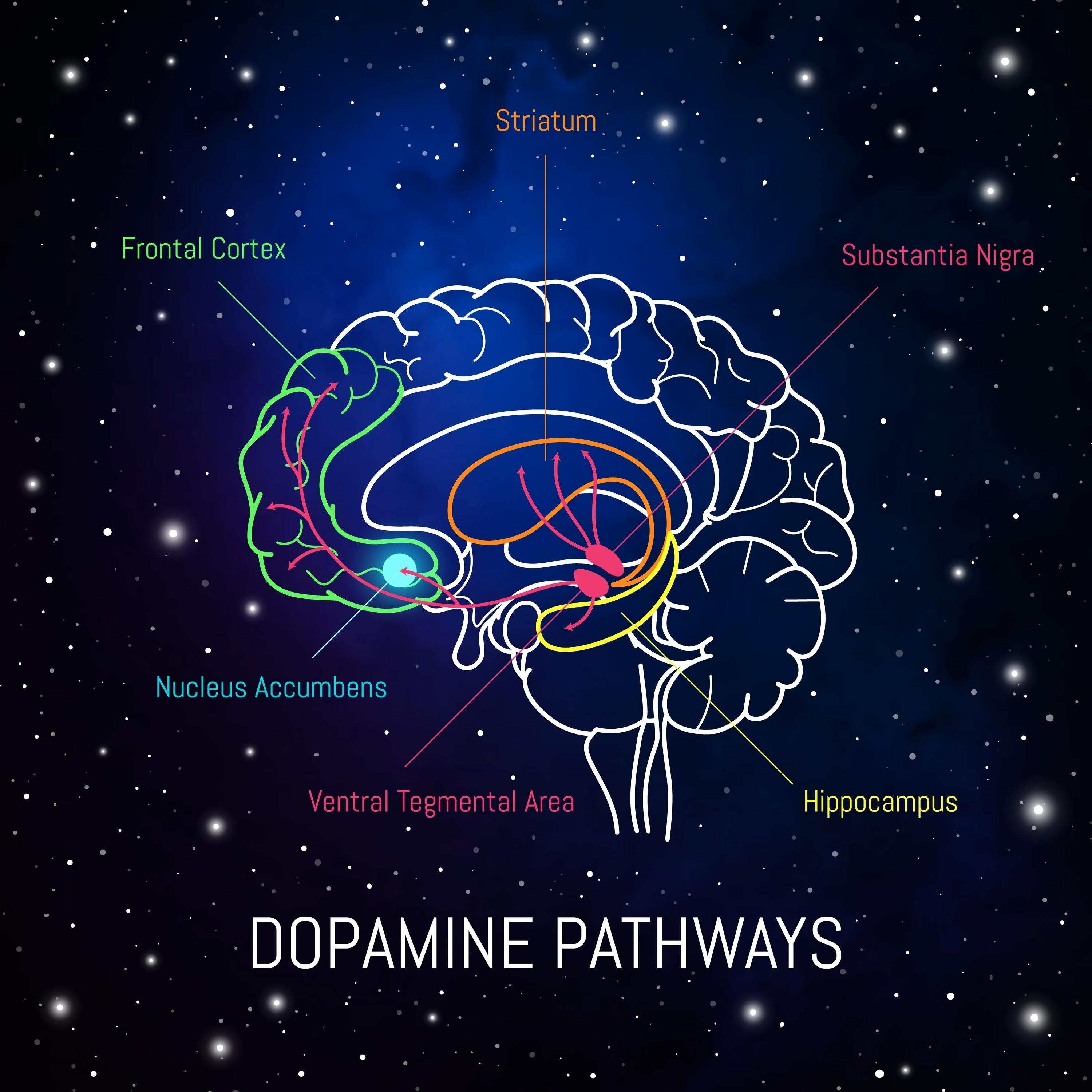
Sometimes the medical jargon (Executive Dysfunction, Dopamine Pathways) is too dense. Here is the easiest way to visualize the difference:
1. The Car Analogy
Imagine everyone is driving the same vehicle.
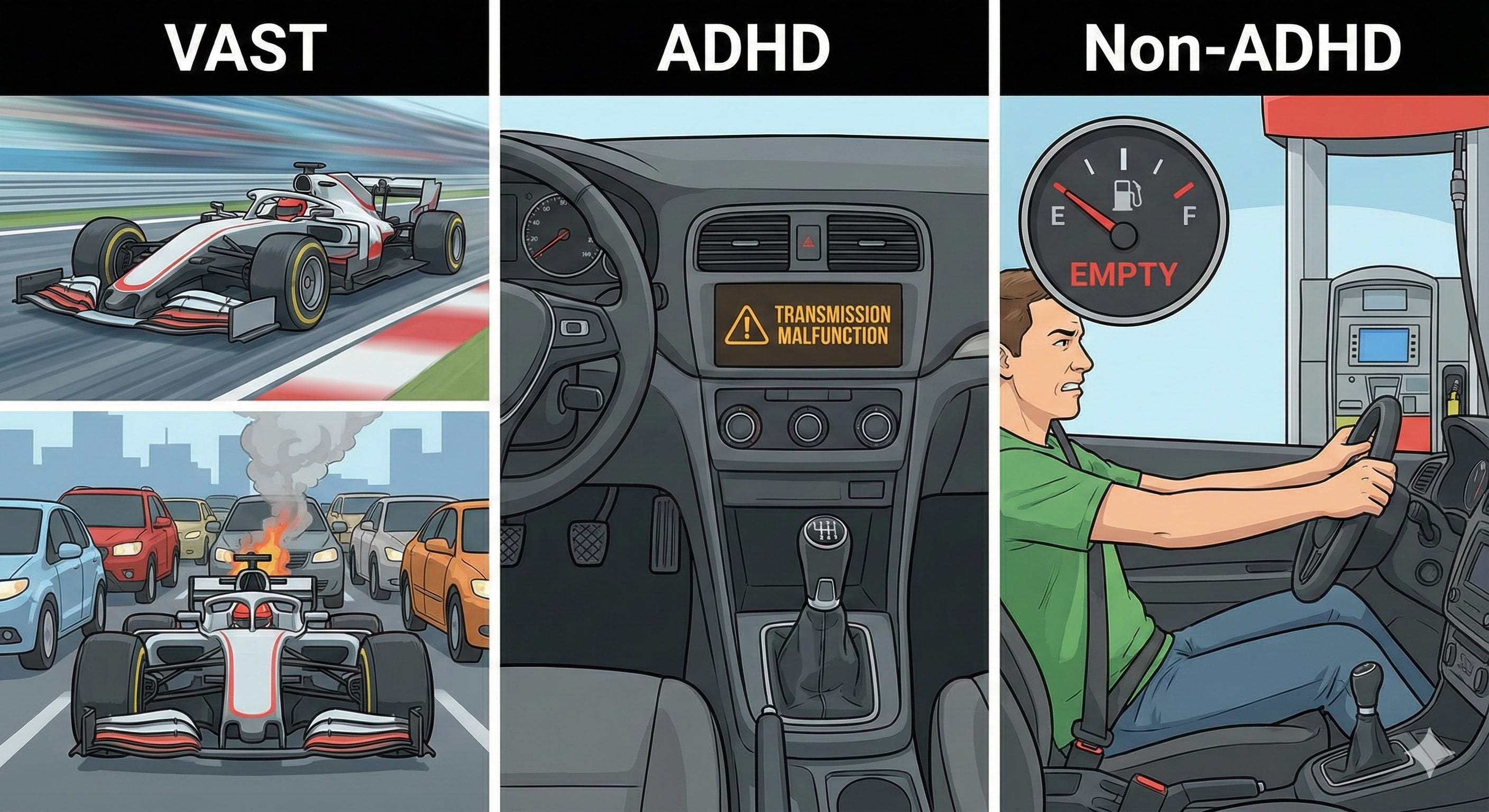
VAST (The Formula 1 Car): The engine is powerful but temperamental. It breaks world records on a race track (High Interest), but it overheats and stalls in slow, boring traffic (Low Interest). It requires speed to function.
ADHD (The Car with a Faulty Transmission): The mechanical gears stick. You try to shift into “Focus,” but the car stays in “Neutral” or slips into “Reverse.” This happens on both race tracks and in traffic. The struggle is the mechanism, not the road.
Non-ADHD (The Car Out of Gas): The car is mechanically perfect. However, right now, the tank is empty (Sleep Deprivation) or the road is covered in ice (High Stress). Refuel the car, and it drives perfectly again.
2. The Smartphone Analogy
Imagine your brain is a smartphone trying to run an app.
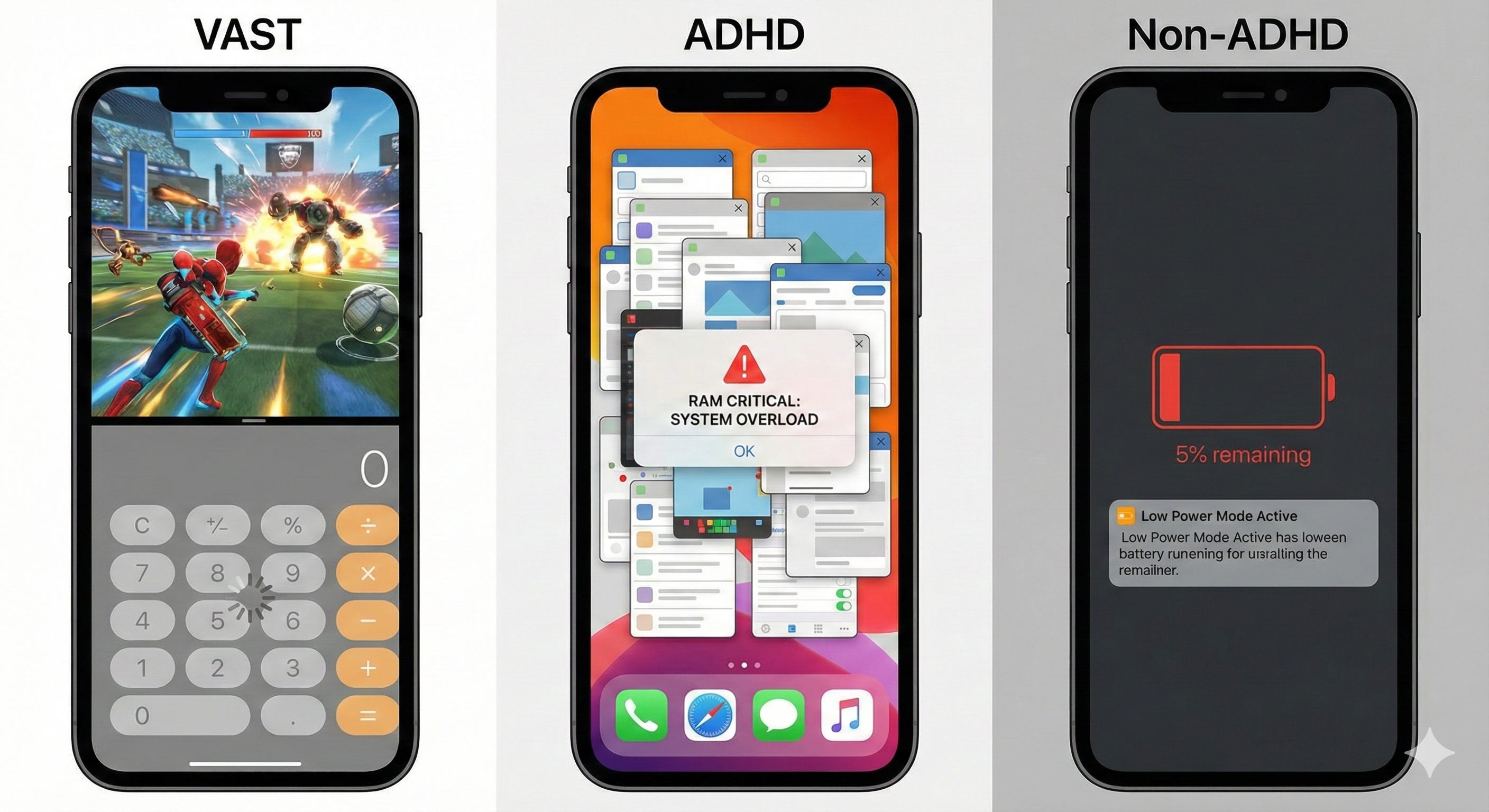
VAST (The Selective OS): Your phone runs high-graphic games at 4K resolution perfectly. But when you try to open the Calculator or Calendar app, the screen freezes. It has specific compatibility issues with boring apps.
ADHD (The RAM Deficit): You have 100 apps running in the background that you can’t close. The phone lags, overheats, and battery drains rapidly, regardless of which app you are trying to use. The issue is system overload.
Non-ADHD (The Low Battery Mode): You are at 5% battery. The phone automatically dims the screen and slows down performance to save power. Once you charge it (Rest/Recovery), full performance returns.
🔮 What To Do Next
If you see yourself in the VAST description, look into “strength-based psychology” and organize your life around your interests.
If you resonate with the ADHD flow—specifically the impairment aspect—seek a clinical evaluation.
If you suspect Non-ADHD factors, audit your “Sleep, Stress, and Screen-time” before jumping to conclusions.
📱 Download the App: Get the Funny, Kind, and Cool perspectives in your pocket at MyCoolSelf.com.
💪 Follow the Journey: Catch my daily roasts and updates on Instagram/TikTok @NoPainNoJoke.
Sources:
Dr. Edward Hallowell (VAST Concept) (AE)
DSM-5 / ICD-11 Criteria (ADHD) (AE)
CDC & APA Guidelines (AE)
Disclaimer: The contents of this newsletter—including text, graphics, and images—are for educational purposes only and do not constitute medical advice, diagnosis, or treatment.
While this article distinguishes between VAST, ADHD, and situational factors, it is not a diagnostic tool. Always seek the advice of a physician or other qualified mental health provider with any questions you may have regarding a medical condition. Never disregard professional medical advice or delay in seeking it because of something you have read here.