

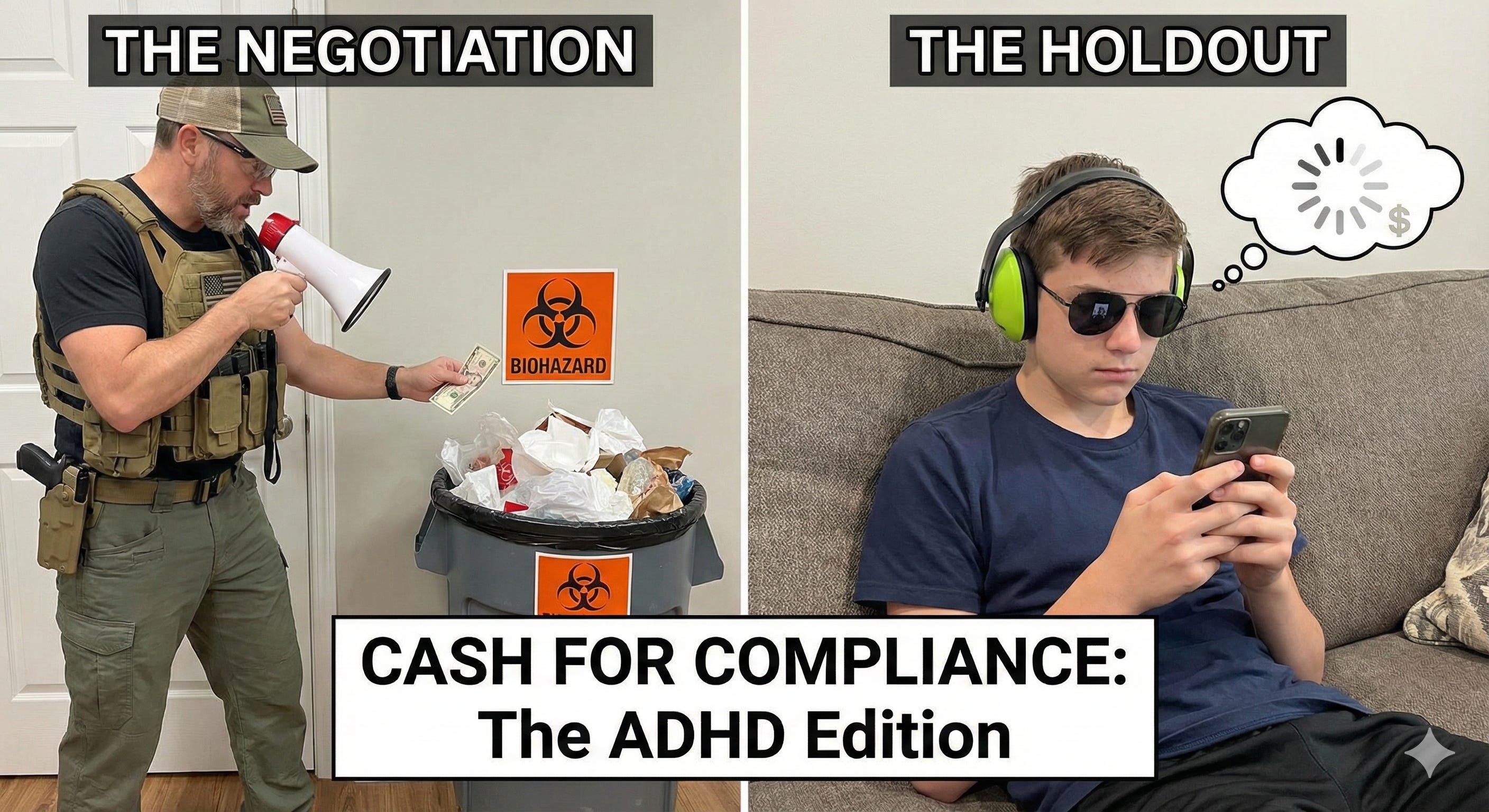
Why paying your teen to follow directions feels like a hostage negotiation—and why you should probably do it anyway.
The scenario is a classic American horror story:
You: “Please take out the trash. It smells like a possum died in a hot yoga studio.”
Your Teen: (Staring at phone, absorbing TikToks by osmosis) “Yeah. In a minute.”
Three hours later. The trash is still there. The possum smell has ripened. You are now vibrating with a specific frequency of rage known only to parents of ADHD teenagers. You are holding a $10 bill, trembling. You think, If I give him this, am I raising a functional adult, or am I funding a future extortion racket?
Let’s strip the “good parenting” guilt and look at the dopamine economics of why bribery—sorry, incentivization—might be the prosthetic executive function your household needs.
The Science of “Why Can’t You Just Do It?”
To a neurotypical brain, completing a boring task like emptying the dishwasher carries a small, internal sense of satisfaction. “I did the thing. I am a responsible citizen.”
To an ADHD brain, a boring task is not just dull; it is physically painful. It is a dopamine desert. Research confirms that ADHD brains have lower levels of dopamine receptors in the reward pathways (Volkow et al., 2009).
Asking an ADHD teen to “just do it” for the “satisfaction of a job well done” is like asking a car to drive without gas because “it’s the right thing to do.” The engine doesn’t care about your morals. It needs fuel.
The Great Debate: Moral High Ground vs. Clean Floor
❌ The “In My Day” Argument
Grandparents and neurotypical critics love this one. They argue that paying for compliance destroys character.
The Fear: “If I pay them to clean their room, they’ll charge me to breathe next week.”
The Science: Psychologists like Edward Deci argue external rewards can kill intrinsic motivation (Deci et al., 1999). (Though, let’s be honest: was there ever any intrinsic motivation to scrub a toilet?)
✅ The “I Just Want Peace” Argument
Proponents argue that money isn’t a treat; it’s an external battery pack for a brain that can’t hold a charge.
The Reality: ADHD brains are time-blind. “Future success” is a ghost. A $5 bill is real, immediate, and floods the brain with the dopamine needed to initiate the sequence.
The ROI: If $5 saves you 45 minutes of screaming and a spiked cortisol level, that is the best financial investment you will make this fiscal year.
The Upgrade: Don’t Pay for Chores, Pay for Training
Here is the twist. Paying for chores can feel icky. But paying for mental reps? That’s education.
We built MyCoolSelf with a “Momentum Score”—a literal gamified metric that tracks how much time you spend engaging with your constructive personas (the “Cool Self” or “Wise Persona”) instead of doom-scrolling.
The Hack:
Instead of paying for the trash, pay for the process.
The Setup: Tell your teen, “I know you don’t want to do the laundry. It sucks. Go talk to the ‘Cool Self’ persona in the app for 10 minutes about why it sucks.”
The Score: The app tracks this engagement and awards a Momentum Score.
The Payout: Set a conversion rate. “Hit 500 Momentum Points this week, and you get $20 (or the Xbox password).”
Why this works:
It forces them to practice cognitive reframing (therapy disguised as a video game).
It removes you as the nag. The app is the referee.
They get the dopamine from the “ding” of the score and the cash money.
The Bridge: How I Trick My Own Brain
I wrote this strategy because I live it. I am a grown man, and I still sometimes need a cookie to answer an email.
I used to shame myself for needing rewards. “Willy, just be an adult.” That didn’t work; it just made me a depressed procrastinator. Now, I run these friction points through my Funny Persona in MyCoolSelf. I challenge myself to get my Momentum Score up before I allow myself a coffee. The app gamifies my own executive dysfunction, turning a “have to” into a “level up.”
The Verdict
If you choose to pay, make it a contract, not a bribe.
Bribery: Paying them to stop screaming in Target. (Bad. Feeds the monster.)
Commissions: Paying them to engage with their “Cool Self” and build the mental muscle to get off the couch. (Good. Feeds the brain.)
We aren’t spoiling them. We are building a ramp over a ten-foot wall.
Safety Audit
❌ Dry/Risky/Offensive✅ Witty/Safe/Resilient Revision“Your kid is a greedy monster.”“Your teen is a dopamine-efficient organism.”“Paying them is the only way they’ll ever function.”“External rewards act as ‘prosthetic motivation’ while internal skills develop.”“Just throw money at the problem.”“Gamify the struggle using the MyCoolSelf Momentum Score.”
Ready to turn “Ugh” into XP?
📱 Download the App: Use the built-in Momentum Score to gamify your teen’s growth (and your own) at MyCoolSelf.com.
💪 Follow the Journey: See how we roast our own ADHD struggles daily on Instagram/TikTok @NoPainNoJoke.
Disclaimer: This content is for entertainment and informational purposes only. It does not constitute professional mental health or medical advice. I am a founder, not a doctor. If your household negotiations involve actual hostages, please call a professional.
Sources:
Volkow, N. D., et al. (2009). Evaluating Dopamine Reward Pathway in ADHD. NIH / ScienceDaily
Deci, E. L., et al. (1999). A meta-analytic review of experiments examining the effects of extrinsic rewards on intrinsic motivation. (AE)
ADDitude Mag. How Rewards and Punishment Work for Children with ADHD. CHADD